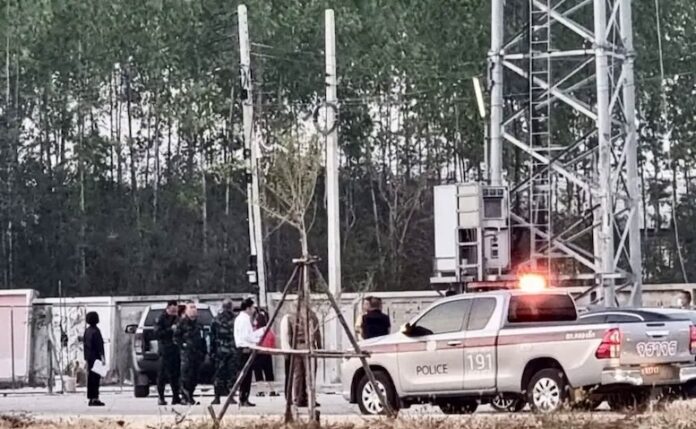
Police and the comms regulator have removed telephone poles in three parts of the Sa Kaeo province of Thailand after it was discovered that some Thai businesses were privately connecting their networks to scam compounds in neighboring Poipet, Cambodia. Lieutenant General Yingyos Thepjumnong of the Royal Thai Police said businesses were violating their contracts with comms providers by supplying internet and telephony connections to ‘dozens’ of locations in Poipet. He also said scammers had set up simboxes on the Cambodian side of the border to connect to networks within Thailand. Trairat Viriyasirikul, the acting Secretary-General of the National Broadcasting and Telecommunication Commission (NBTC), added that the removal of the poles and curtailing of mobile transmissions would not affect users within Thailand.
Cambodian police were dismissive when responding to press enquiries about the scam compounds targeted by the Thai operation. Per the Cambodian Journalists Alliance Association:
National and provincial police in Cambodia have denied the investigation and action, calling it a one-sided decision rather than a joint effort with corroboration from the Cambodian side.
“This is a unilateral announcement, they [Thai police] haven’t conducted a joint investigation with Cambodian police counterparts at all, so whether they [scam centers] exist or not, is based on the Thai’s claims,” said National Police spokesperson Chhay Kim Khoeun.
The police chief for the province containing Poipet pretended there were no scam compounds in the city.
Banteay Meanchey provincial police chief Sith Luos also denied scam centers operate in his jurisdiction, dismissing the telecom cuts as based on “allegations” and saying Thai authorities have not collaborated with his department.
There is no shortage of evidence showing scam activity in Poipet. For example, a Thai money mule described in detail how he was trafficked to Poipet and then escaped back across the border after being confined within a scam call center. Earlier this month the Thai police seized comms equipment being transported from a scam compound in Myanmar to Sa Kaeo and then to a new scam center in Cambodia. The construction of scam compounds around Poipet can even be seen from space.
The grumbling of senior Cambodian police officers reinforces accusations that criminal syndicates which run scam compounds have been protected by the corruption of the Cambodian government and law enforcement. Earlier this month, two Cambodian journalists were detained and forced to apologize for sharing a video depicting the alleged torture of a scammer forced to work in a scam compound. The police issued a press release accusing the journalists of spreading disinformation. The Committee to Protect Journalists called for the immediate release of the journalists whilst highlighting a pattern of journalists being harassed when they report on scam compounds. This includes the arrest in 2024 of Mech Dara, one of the most prominent investigators of scam compounds and the cross-border trafficking of people who are made to work as scammers.
Thailand has repeatedly shown it will cut cables and destroy radio masts that provide network connectivity to scammers in Cambodia. However, it is not just Thais that are victimized by scammers working in the multilingual call centers operated within Cambodia. Every country should be prepared to impose sanctions on corrupt Cambodian officials who have given organized crime the freedom to run scam compounds with impunity.