There are few things I enjoy more than rubbishing Josh Bercu, a Washington DC lobbyist paid a quarter-million dollars each year by a consortium of US telcos to persuade Washington DC decision-makers that his paymasters are doing a fabulous job of reducing unwanted and harmful communications. To be fair, Bercu has tried to reduce my awareness of the garbage he spouts by blocking me on LinkedIn, as if that will stop me hearing about the cherrypicked statistics he presents when speaking to audiences on both sides of the Atlantic. I would simply push his existence to the back of my mind if he was only seeking to influence policy in the USA, but I object to him using mangled statistics to influence the policies of other countries too. His shenanigans annoy me for two reasons:
- the USA is doing a terrible job at protecting phone users from unwanted and harmful communications; and
- other countries are doing a better job of protecting phone users from unwanted and harmful communications.
If anybody should be giving advice on how to reduce unwanted and harmful communications, it should be foreigners giving advice to Bercu and his paymasters, not vice versa.
I can prove my point using the same data that Bercu cites when he asserts how well the US strategy has performed in practice. The following is taken from testimony Bercu gave to a Congressional committee on June 4, 2025 as per his prepared notes and the video recording of his actual contribution. That committee included Frank Pallone, the man who lent his name to the Pallone-Thune Telephone Robocall Abuse Criminal Enforcement and Deterrence (TRACED) Act.
The headline is this: the TRACED Act worked. It created an evolving framework that now enables disruption of illegal calling campaigns, better accountability, and targeted enforcement.
Excuse me as I gag on Bercu’s sycophancy. But what demonstrates that the TRACED Act worked? According to Bercu, it is the number of complaints made by Americans to the Federal Trade Commission (FTC).
The numbers tell a compelling story. When Congress passed the TRACED Act in late 2019, illegal robocalls were nearing a crisis point. Robocall complaints at the FTC had more than doubled from about 1.7 million in 2014 to 4.5 million in 2017, and stayed just shy of 4 million prior to the TRACED Act’s passage. The robocalls leading to these complaints were typically high-volume campaigns that predominantly used spoofed numbers, and automated and prerecorded voice messages at their core. Past illegal robocall campaigns were part of large-scale “fishing with dynamite” scams or illegal telemarketing schemes that exploited regulatory gaps and weaknesses in the phone network.
As of today, those complaints have declined by more than 70%.
That is a pretty strong argument, especially if you ignore the following.
- Correlation is not causation. A drop in the number of complaints at the same time as something else occurred does not demonstrate a causal link.
- No man is an island. Unwanted calls received by Americans may have a domestic or foreign origin. Bercu is the kind of man who keeps trying to influence what other countries will do but gives no credit to the work they have already done.
- Even the strong need rest. The fatigue felt by consumers who need to repeatedly complain about the same problem is impossible to measure, as is its impact on complaint statistics.
There are also specific problems with the ‘more than 70%’ statistic that Bercu quoted.
- The TRACED Act was not just passed in late 2019 as Bercu states; it was passed on December 30, 2019. Any fall in the number of complaints should not be measured from whichever arbitrary point in 2019 that Bercu selected for his ‘more than 70%’ statistic but from the beginning of 2020.
- The number of complaints fell precipitously after the Act was passed then rose sharply again, to levels well above the average for the final months of 2019. Complaints in August 2020 were above the number of complaints for November 2019 and remained elevated for many months afterwards, reaching a new peak in March 2021 before a downward trend emerged.
- The only way to generate a statistic where the number of complaints fell by over 70% since the TRACED Act was passed would involve comparing the number of complaints during the March 2021 peak with the number of complaints during the very lowest months since. There are only four months that yield a difference greater than 70%: December 2022, September 2023, December 2023, and December 2024. December statistics should be discounted because this month is always an outlier with an unusually low number of complaints.
- Complaint levels were flat during the whole of 2024 but have risen again in 2025.
I have noticed Bercu quoting cherrypicked statistics on several occasions, both when speaking to live audiences and when making posts to social media. I assume this motivated his decision to block me on LinkedIn; he does not want anybody to publicly correct his misuse of data.
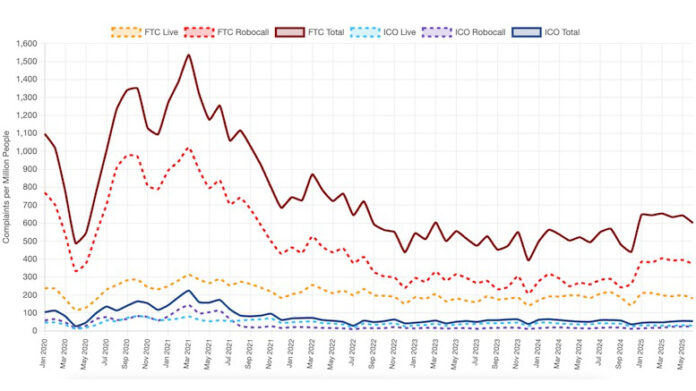
Having admitted the existence of complaint fatigue, let us agree to put that aside so we can compare how often Brits complain about unwanted calls with the number of complaints made by Americans. The following chart is a recent snapshot taken from a new rolling graph that is automatically updated for our Global Fraud Dashboard. Unlike Bercu’s vague reference to ‘late 2019’, you will see this graph begins in January 2020, and covers the full story since the TRACED Act was passed.
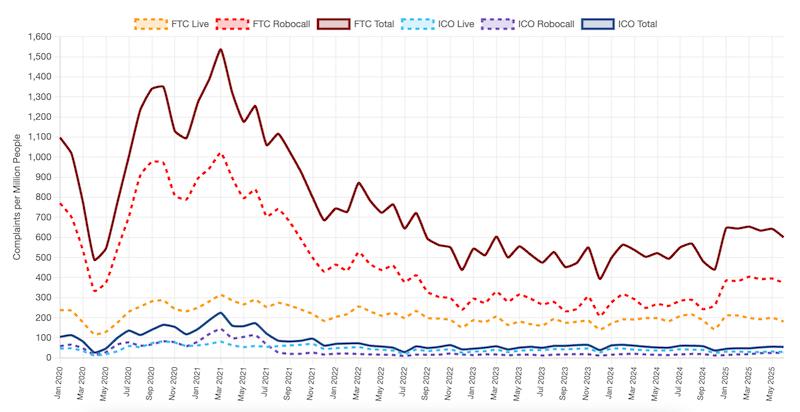
The lines in yellow, red and brown show the number of complaints about unwanted calls received by the FTC from January 2020 to June 2025 per every million of the population. The complaints about live calls are in yellow, the complaints about automated calls in red, and the total for complaints about all calls is in brown. Notice how they compare to the equivalent lines in shades of blue and purple that come from the Information Commissioner’s Office (ICO) in the UK. ICO uses synonymous definitions to the FTC, giving us a robust like-for-like comparison when comparing the number of complaints in each country. People with very limited statistical skills — politicians, lawyers etc — should already apprehend my point. There are far fewer complaints about unwanted calls in Britain compared to the USA, even after adjusting for the different populations.
Now, if you are a grossly overpaid American lobbyist you may want to invent reasons to question whether the American and British lines are truly comparable, even though one country is very obviously doing better than the other. For example, some snide fool may suggest Brits complain less than Americans. They may insist Brits are perpetuating a parody of how their ancestors behaved during the Blitz by refusing to complain when everything is collapsing around them. Brits no longer behave like that; it is more likely that Brits will make fun of that particular cliché. But however many fact-free arguments are made about different propensities to complain, the graph above is not the most important graph in this analysis. The next graph is also a snapshot from another rolling comparison now included in the Global Fraud Dashboard.
Per Bercu’s argument, what really matters is the current level of complaints relative to the levels experienced in the past. By that measure, the UK is also better at reducing unwanted calls than the USA. The following graph is derived from the same data as the one above, but is indexed to January 2020 so it only shows the relative changes in the number of complaints since then.
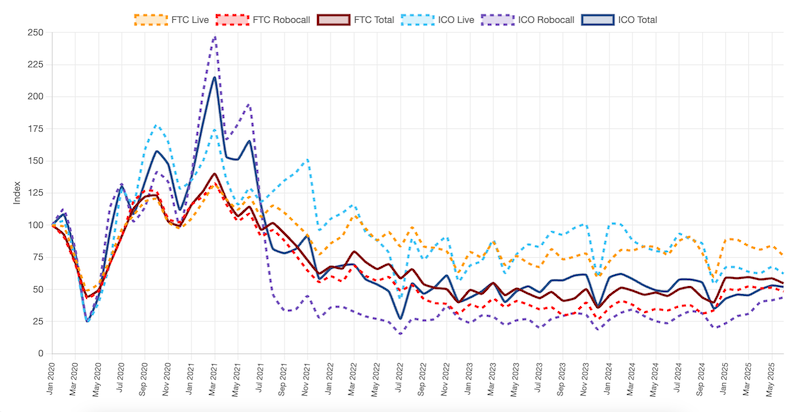
British complaints in June 2025 were at 51.9% of their level in January 2020. In comparison, American complaints in June 2025 were at 54.7% of their level in January 2020. Contrary to Bercu’s ‘more than 70%’ claim, American complaints have not even fallen by half, relative to the first full month since the TRACED Act was passed. British audiences who listen to the claims made by Bercu may wrongly conclude that American complaints have fallen faster than British complaints but this is only because Bercu has exaggerated the fall in American complaints. Comparing January 2020 to June 2025 shows that complaints about unwanted calls in Britain have undergone a larger proportionate fall than complaints about unwanted calls in the USA.
That Britain has delivered a 48.1% fall in complaints between January 2020 and June 2025 is pleasing, but does not sound much better than the 45.3% fall for the USA. But suppose I wanted to pull the same statistical trick as Bercu, by selecting periods for comparison just because they would yield the largest proportionate reduction. The result would be even more flattering for the UK than for the USA. Both countries experienced a sharp peak in complaints during March 2021. Complaints made by Brits are down 76% since then. Complaints made by Americans are only down 61% over the same period.
So if success is measured by the relative reduction in the number of complaints, the UK is outperforming the USA by every reasonable measure in the period since the TRACED Act became law. The accomplishment of British telcos and the British authorities is even more impressive when you consider that reducing a low number of complaints is much more difficult than reducing a high number of complaints because of the law of diminishing returns.
Bercu’s testimony to Congress emphasized how much progress had been made because US telcos focused on reducing the number of highly repetitive recorded calls received by Americans. That succinctly explains why it was so much easier for the US to engineer a relative reduction in complaints. Very simple control improvements and modest enforcement action will deliver a massive reduction in unwanted calls if the communications sector first allows an enormous explosion in automated calls from just a few bad actors. To persuade the audience that the US telecoms sector has done a good job of reducing unwanted calls requires the audience to remain ignorant of how far US telcos allowed the problem of unwanted calls to grow unchecked because it was so very profitable for them. That selfish behavior would not have been tolerated in most other countries.
Americans currently make twice as many complaints about automated calls as live calls, while Brits make more complaints about live calls than automated calls. Britain has already reached a level where there are no more easy victories to be had by finding and stopping large-scale automated campaigns. The USA still has not reached that point. On the contrary, American complaints about robocalls went sharply up at the beginning of 2025 and have not fallen back since.
There are other reasons to question the quality of information being presented to US policymakers. For example, how should we reconcile the number of complaints received by the FTC with a large unbiased survey finding 31% of Americans receive one scam call per day? I doubt any advocates of the current US strategy will choose to say anything about that particular statistic, although there are signs that other politicians want evidence of an ongoing scam epidemic.
If American politicians really wanted to learn how to reduce unwanted calls, they would ask some Brits to fly over and explain how they lowered the number of unwanted calls from a base that was already much lower than that found in the USA. American policymakers have far more to learn from Britain’s example than Brits will learn by listening to Josh Bercu and his biased measures of American ‘success’.