
Please let me share a secret that I have been harboring for 60 days: I thought the fundraising campaign for the Commsrisk Global Fraud Dashboard was destined to fall short of its target. The response to its launch was muted. As a result, I doubted we would come close to half of the amount we asked for. There is a note in my diary with instructions for how to excuse our failure today. Now I find myself needing to thank all the donors instead. We passed the target of GBP7,250 (USD9,750) with one day to spare. Then we received a surge of donations on the final day, pushing the total much higher. The combined generosity of our supporters has been astounding. No amount of thanks will be enough.
I will thank every donor, with a personal message for each of them, over the course of the next few days. Their names will be listed on the dashboard. But for today, collective thanks will have to do. Running the campaign while adding lots of new charts required a 60‑day sprint. It has been exhausting to do that work while also making time to attend MWC Barcelona, the Global Fraud Summit, and an EU cybersecurity event in Brussels. I am knackered. Thankfully, our chief developer, James Greenley, has performed Herculean feats. There are not many developers who could have delivered so many new automated charts while also producing all our campaign materials, including the stunning campaign video and the thermometer graphics that updated whenever a new donation was received.
The campaign has shown how many good people we have met through Commsrisk. It also reminded us of how many bad people plague the internet. Our lack of experience on Kickstarter, and with crowdfunding in general, meant we were surprised by how many scammers mobbed our campaign. Their methods were easy to discern. Some contacted us through Kickstarter to promise big donations, but only with strings attached. Pledges like these are a ruse to lure unwary victims into dropping their guard before embroiling them in a long con. Meanwhile, bots on LinkedIn have been auto-liking, auto-reposting and auto-commenting on any post that mentions crowdfunding or Kickstarter. The scripted comments are designed to flatter the fundraiser’s ego before advising that such-and-such business could make introductions to new prospective backers.
These unpleasant experiences added to our initial pessimism, but now they make us more determined. Social media companies and online platforms are obviously failing to perform basic checks that would reveal repetitive automated scam activity. Over time, I want the dashboard to begin measuring their failures too. The internet industry thinks it can swallow telephony whole, with the result that calls and messaging will be better and safer than before. Their technology will take over for economic reasons; a culture that embraces reckless hype and slipshod delivery is less welcome. Many of the scams that have exploded across the telecoms sphere are rooted in internet flaws. There would be no reason to buy SMS blasters to send smishing messages if there were no phishing websites. SIM farms with many thousands of previously unused SIM cards exist because criminals pay them to create accounts on WhatsApp, dating websites and online marketplaces. The ‘solution’ to junk email has been to hand control to a small number of multinational businesses. Restoring trust in communications is going to involve a lot more than replicating controls that still leave most of cyberspace in a cyberswamp.
But today is a day for optimism, and my hopes are lifted when I think of the charts we have added to the dashboard in the last few weeks, and of the charts that will be added because the funding for further development has been secured. We have been so busy asking for money that we barely made time to explain a plethora of new content that has been added to the dashboard, including:
- Ten new charts that extract data about phone scams from police reports in Singapore, a country that is setting the pace for anti-scam controls;
- Six new charts analyzing enforcement of the General Data Protection Regulation (GDPR) for telcos, internet and media companies across Europe;
- New graphs that show the collective value of scam losses instigated by a phone call or text message, as reported by victims in the USA and Australia; and
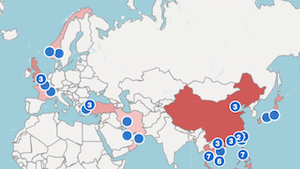
- New comparison graphs that illustrate the relative effectiveness of anti-scam policies in different countries.
There is a lot in the development pipeline too. Expect to see the following additions to the dashboard soon:
- AI-powered summarization of reported US scam call volumes that have never been publicly collated before;
- Analysis of scam trends per recent consumer surveys in various countries;
- Automated metrics of anti-scam activity in South Korea;
- SIM swap metrics from the USA; and
- A completely new measure that monitors official announcements about blocking and then estimates how many calls and messages are currently being blocked by different countries around the world.
We are on a journey. You are on that journey with us. Each new chart we add to the dashboard gives us a better appreciation of the next step that needs to be taken. The support of a wide range of benefactors is the best safeguard against bias influencing our work, and I want you to call out if you ever believe we have strayed from the correct path. It is my belief that this work will lead to a better future. In the meantime, my thanks go to everyone who has brightened today.