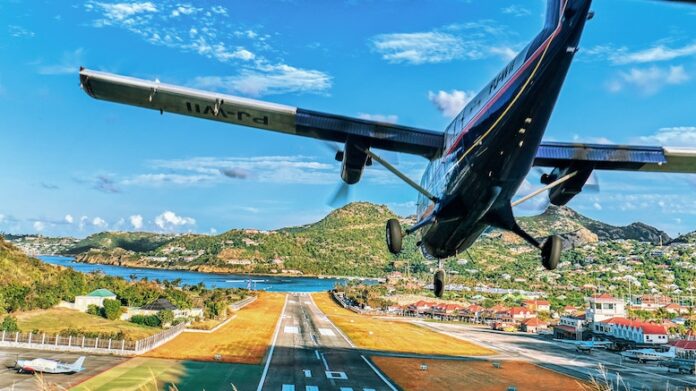
When I am not managing risk for telcos, I fly planes. Flying always involves learning, because there has never been a pilot who had too much experience. When learning to fly, some students struggle with landings. It is no wonder that YouTube is full of landing tutorials. A safe landing calls for good management of energy, making firm and positive changes, good depth perception and above all, a relaxed but careful attitude as the plane comes close to the ground.
Beyond safety, landings are also matter of pride. A scenic flight is ruined (at the end) by a bad landing. The taste just refuses to go away.
There is one bit of advice that grey-haired instructors give: do not try to land — the plane will land when it is ready to. So many beautiful planes have been driven right into the ground, quite unnecessarily, simply because the pilot tried to make the plane land. Mercifully, runways cannot talk. Generally, it should be possible to land a properly trimmed plane by using one hand on the throttle and keeping one thumb and two fingers on the control yoke. Rushing the plane leads to broken bits, tears and increased insurance premiums. Repeat offenders, who survive, may also be invited to have tea with the Chief Pilot — and during such a tea break, they will not be offered biscuits.
A pilot’s goal, once over the threshold of the runway is simple: cut the power and try to fly the plane to the end of the runway, tracking right on top of the centreline. He must keep pulling the stick back, gently and firmly, to generate lift so that the plane can fly as it dissipates energy. The feet should be ready on the rudder to keep the aircraft’s nose straight. Gentle but firm corrections, easy does it. Then, it is only a matter of time before the plane runs out of lift, inches above the ground and the wheels kiss the ground. More often than not, bad landings are caused by over-controlling.
If you do it well, the wheels will touch down so softly that for a moment you will wonder if you are still in the air or already on the ground.
These perfect landings are called greasers or butter landings, but they only happen when flying solo. The gods have decreed that with passengers on board, that is not a joy that is to be allowed for pilots. Bad landings that are witnessed by passengers ensure that pilots are humbled. Especially when you have nervous passengers or passengers that you wish to impress, the gods generously dish out hard landings, off-centre landings, ballooned landings and bounced landings. If there is a crowd watching, a combination of these embarrassments is to be expected. This is how excuses such as “a sudden tailwind/crosswind” came into aviation parlance and pilots are fond of these phrases.
There is also one lesson that all pilots have to bear at all points of the approach and landing. If there is ever as moment when things do not look right, apply full power, raise the plane’s nose to climb attitude and circle back for another try. Again, lives and planes have been lost because some pilots thought a go-around is embarrassing. Instructors drill students that one hand must be on the throttle throughout the whole approach and landing stage — and that is for a good reason. In the time it takes to count 1-2-3, it should be possible to feed gas to the bird and take off back into the sky, where the options, with airspeed and altitude, are more.
A good landing comes after a good approach. Approach hot and high, you will struggle to put the plane on the tarmac with steep descent and airspeed all over. Approach low and slow, suddenly the houses under the flight path become bigger. What you did 15 nautical miles away may determine how the landing will be.
In risk management I have seen telcos operating like nervous flight students.
- They fail to whittle down all the initiatives being undertaken into a manageable set of easy ones that have the greatest benefit. It is almost as if doing easy things is seen as laziness. It appears doing something easy is hard for so many people, after all.
- They do not have a clear way out of (clearly bad) situations. Consequently, people watch each other as the company heads to a crash. The next time you are at the airport and see a jetliner perform a go-around from just a few metres above the runway, ask yourself if the organization you work for would ever unabashedly abandon an initiative and go back to the drawing board.
- Many telcos hardly prepare for success, though they say that they do. It is almost as if being in a dynamic environment is an excuse to be sloppy. Is it some fatalism syndrome? Why, for example, are services launched and we later discover the billing is not okay? Why are privacy breaches still so rampant? Is it because those who are charged with the role of doing such things never get punished or are we just inept?
Lastly, after a hard landing, do not be the irritant who remarks to the pilot, “hard landing, hmm”. Instead, just say, “bit of a nasty gust there as we came in, mate”. Your pilot will be eternally grateful.