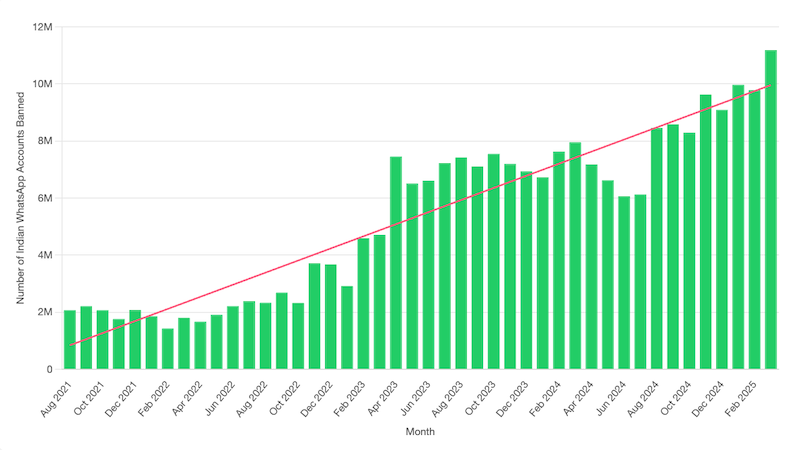
One way to protect the public involves identifying the user accounts responsible for harmful communications and then taking those accounts out of service. In the past, such a process would only have been instigated after a member of the public complained about some communication they had already received. Now the focus needs to shift towards proactive identification of accounts created by bots before they can do harm. New data from India underlines why the transition towards automated detection of harmful accounts must be accelerated. An astonishing 11.2mn Whatsapp accounts associated with Indian phone numbers were banned during March, representing a 14% rise on February. This established a new all-time record for the number of Indian WhatsApp accounts banned in a single month.
The number of Indian WhatsApp account bans during February was only slightly down on the total for January. That fall only occurred because February is a short month. January set the previous all-time record, with almost 10mn accounts banned during that month. In total, 30.9mn Indian WhatsApp accounts were banned during the first quarter of 2025. If the number of bans stabilizes over the next three quarters then there will be a 34% rise in bans during 2025 compared to 2024. However, if the figures keep rising at the rates witnessed over the last six months then there will be over 150mn WhatsApp accounts associated with Indian phone numbers banned during 2025, which would be a 63% rise year-on-year. India is a large country, but it is astonishing that Indian phone numbers might be used to create the equivalent of one scam or spam WhatsApp account for every 10 Indians within a single year.
These mind-boggling statistics show how computers are changing the nature of networked crime. Old paradigms for detecting and responding to criminal behavior will be obliterated by the scale of the criminal onslaught. Waiting for the public to complain is not good enough. Entire industries need to be rewired so criminal activity is stopped before it can occur. The problem is especially profound for over-the-top communications platforms like WhatsApp, which is owned by Meta. Providing a free service to millions of users is essential to their business model but it also means criminals incur no cost when they create multiple accounts for the purpose of committing fraud. The only limits on criminal activity are the controls put in place to tackle it, the cost of the CPU power available to the criminals, and the number of phone numbers that can be used to register accounts. This implies we need tighter controls on the supply and verification of phone numbers as well as tighter controls downstream. Prioritizing controls over the creation of criminal accounts is preferable to demanding automated analysis of the contents of private communications, although some will inevitably demand the latter for reasons that have little to do with consumer protection.
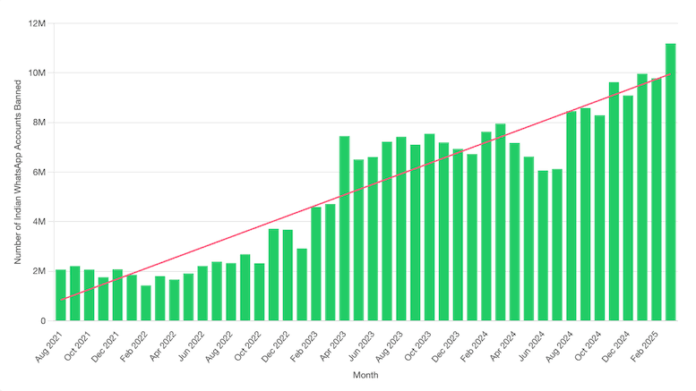
The statistics compiled for this article will soon become part of the regular output of Commsrisk’s new Global Fraud Dashboard. We will be using automation in a positive way, to collate data from multiple sources around the world so trends can be analyzed objectively. In the meantime, look below for our most recent graph of the trend for Indian WhatsApp bans.